Interrogating intra-tumoral heterogeneity using Multi-modal Foundation models
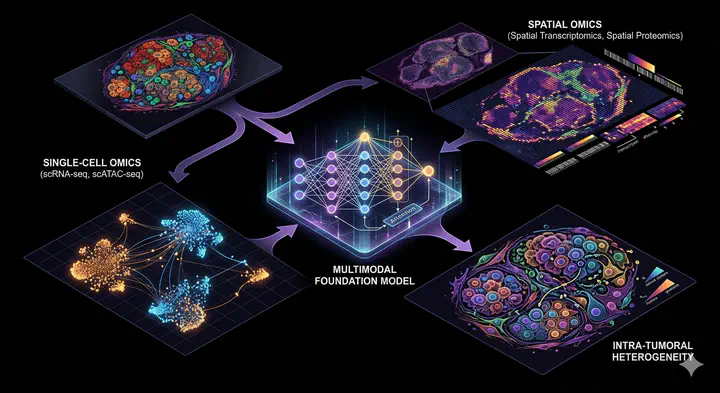
Interrogating intra-tumoral heterogeneity using Multi-modal Foundation models
Cancer is often characterized by profound intra-tumoral heterogeneity, with multiple distinct cellular subpopulations often coexisting within the same lesion or dispersed across different tumor foci. It is a major cause of treatment failure in cancer. This diversity in cellular composition, genetic alterations, and functional states is a major cause of treatment failure, as it enables tumors to adapt, resist therapies, and recur.
Single-cell profiling provides the necessary resolution to identify individual cell-types whereas, spatial-omics profiling provides us the ability to deconstruct the complex architecture of the tumor neighbourhood. In other words, while single-cell approaches define “what” cells are present, spatial-omics is essential for understanding “where” they reside and how their location influences behavior.
To bridge these layers of complexities, multi-modal foundation models have emerged as a transformative ML-based tool for interrogating intra-tumor heterogeneity. By training on large diverse datasets, including histopathology slides, genomics, transcriptomics, proteomic, and epigenomic single-cell and spatial profiles, these models can “cross-talk” between modalities. This integrative approach may enable us to identify rare, therapy-resistant clones that might be missed by a single modality, providing a holistic view of the tumor’s evolutionary trajectory and its response to the microenvironment.